Today is more better compared to yesterday since we have observed a lower death toll rise.
death toll = 116 during last 24 hours and 4823 new cases diagnosed with positive.
total = nearly 1370 ( two outside china)
Outside China there had been two deaths and 447 cases in 24 countries
On Thursday Japan announced its first coronavirus death - a woman in her 80s who lived in Kanagawa, south-west of Tokyo.
The woman's diagnosis was confirmed after her death and she had no obvious link to China's Hubei province, the epicentre of the outbreak, Japanese media reported.
What is happening on the Diamond Princess?
The vessel is in quarantine in Yokohama. Not all the 3,700 people on board have been tested yet.
People with the virus are taken to hospitals on land to be treated, while those on board are largely confined to their cabins.
Image copyrightAFP
Image caption
The Diamond Princess has 3,700 people on board - not all of whom have been tested
However on Thursday Japan said it would allow those aged 80 or over who have tested negative for the coronavirus to disembark.
Health Minister Katsunobu Kato said they could be allowed off the ship as early as Friday but would have to stay in accommodation provided by the government, the Japan Times reported.
Meanwhile another cruise ship - the MS Westerdam - carrying more than 2,000 people docked in Cambodia after being turned away by ports in Japan, Taiwan, Guam, the Philippines and Thailand despite having no sick patients on board.
Coronavirus death toll surpasses 1,000 in mainland China
Taiwan raises travel alerts for Hong Kong, Macao, Singapore and Thailand
Hong Kong and Macao: Taiwan has raised the travel alerts for the two semi-autonomous Chinese cities to level three, which urges the public not to travel to a location unless it's "necessary." Hong Kong has confirmed 42 cases and one fatality, while Macao has identified 10 infected patients.
Singapore: Taiwan raised the travel alert to Singapore to level two, which urges citizens to take "protective measures" if they travel there. Forty-five cases have been identified in the city state.
Thailand: Taiwanese authorities raised the travel alert to Thailand to level one, urging people heading there to "adhere to local preventive measures." The country has confirmed 33 coronavirus cases.
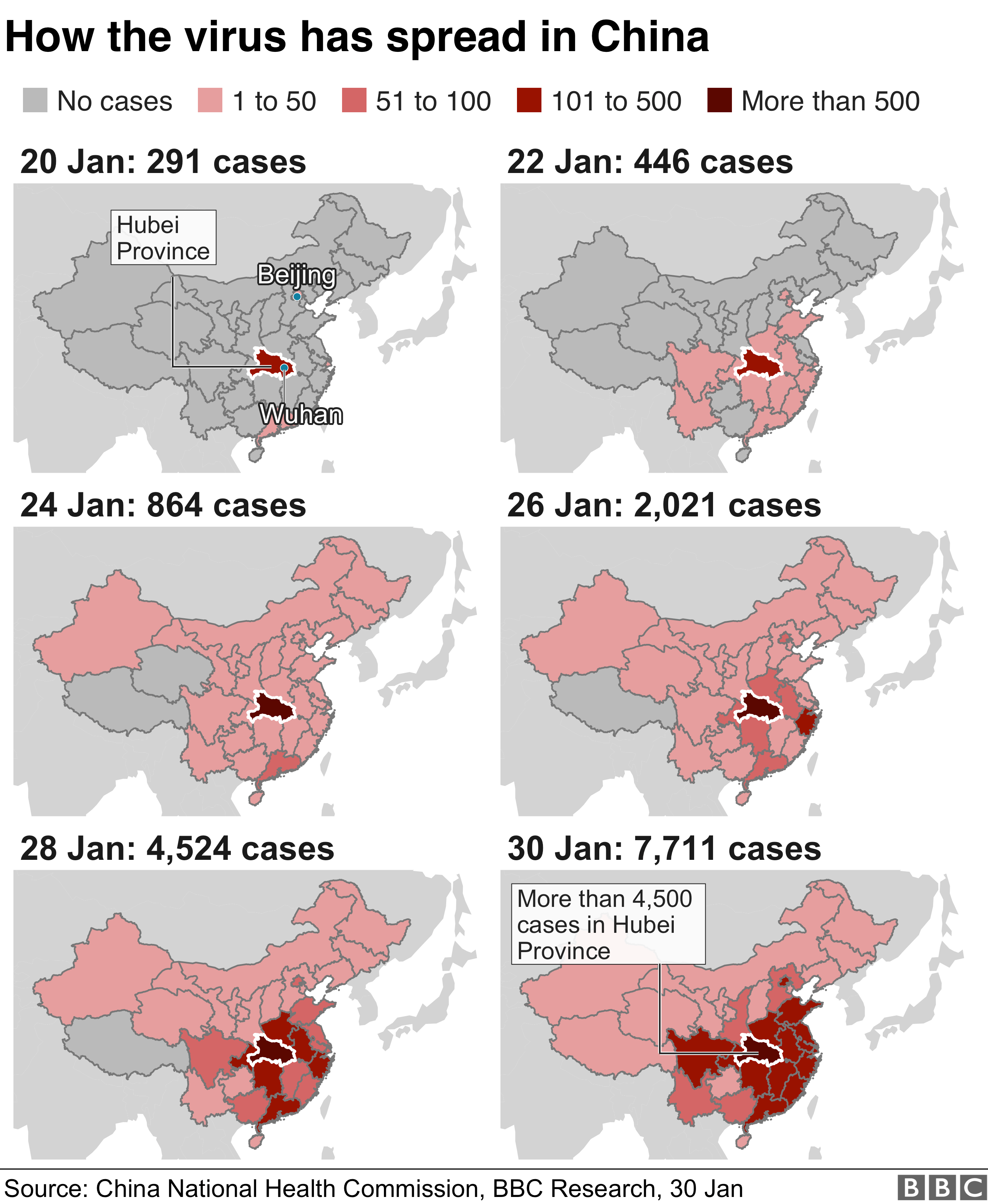
The death toll from the coronavirus outbreak has risen to 170, and a confirmed case in Tibet means it has reached every region in mainland China.
Chinese health authorities said there were 7,711 confirmed cases in the country as of 29 January.
Infections have also spread to at least 15 other countries.
The World Health Organization (WHO) are again meeting in Geneva to consider whether the virus should be declared a global health emergency.
Various countries have implemented evacuation and quarantine plans for nationals wanting to return from China, where the outbreak began in the city of Wuhan.
Russia has decided to close its 4,300km (2,670-mile) far-eastern border with China in an attempt to stop contagion.
WHO Director-General Tedros Adhanom Ghebreyesus named Germany, Vietnam and Japan, as places where people had caught the virus from others who had visited China.
What's the latest on evacuations?
Voluntary evacuations of hundreds of foreign nationals from Wuhan are under way to help people who want to leave the closed-off city and return to their countries.
The UK, Australia, South Korea, Singapore and New Zealand are expected to quarantine all evacuees for two weeks to monitor them for symptoms and avoid any contagion.
Australia plans to quarantine its evacuees on Christmas Island, 2,000km (1,200 miles) from the mainland in a detention centre that has been used to house asylum seekers.
Singapore is setting up a quarantine facility on Pulau Ubin, an island north-east of the city-state's mainland.
Six thousand people on board a cruise ship in Italy were barred from disembarking after a Chinese passenger was suspected of having coronavirus; however initial tests have come back as negative
Flights to take British and South Korean citizens out of Wuhan have both been delayed after relevant permissions from the Chinese authorities did not come through
Two flights to Japan have already landed in Tokyo. Three passengers have so far tested positive for the virus, Japanese media report
Around 200 US citizens have been flown out of Wuhan and are being isolated at a military base in California for at least 72 hours
Two aircraft are due to fly EU citizens home with 250 French nationals leaving on the first flight
India has confirmed its first case of the virus - a student in the southern state of Kerala who was studying in Wuhan
How is China handling the outbreak?
Although questions have been raised about transparency, the WHO has praised China's handling of the outbreak. President Xi Jinping has vowed to defeat what he called a "devil" virus.
The central province of Hubei, where nearly all deaths have occurred, is in a state of lockdown. The province of 60 million people is home to Wuhan, the heart of the outbreak.
The city has effectively been sealed off and China has put numerous transport restrictions in place to curb the spread of the virus.
People who have been in Hubei are also being told by their employers to work from home until it is considered safe for them to return.
The virus is affecting China's economy, the world's second-largest, with a growing number of countries advising their citizens to avoid all non-essential travel to the country.
There have been reports of food shortages in some places. State media says authorities are "stepping up efforts to ensure continuous supply and stable prices".
The Chinese Football Association has announced the postponement of all games in the 2020 season.
Who has been affected?
Although there have been nearly 8,000 infections, there has been little detailed information released on the profiles of patients and how the disease affects them.
Most of the confirmed cases involve people either from Wuhan or who had close contact with someone who had been there.
Of the 425, 55% diagnosed before 1 January were linked to the seafood and animal market believed to be at the centre of the outbreak, compared with 8.6% of the subsequent cases
The average age was 59 years and 56% were men
Almost half the 425 cases were adults 60 years of age or older
Human-to-human transmission among close contacts has occurred since the middle of December
In its early stages, the epidemic doubled in size every seven days
89% of the patients were not hospitalised until at least day five of illness
Corona virus, which was started in a city in china in a illegal market is spreading its wings globally.
China has been reporting over 100 cases today officially.
What is the new coronavirus?
The virus causes severe acute respiratory infection and symptoms seem to start with a fever, followed by a dry cough. After a week, some people can experience shortness of breath and need hospital treatment.
The virus itself is a new, or "novel" coronavirus - a family that normally affects animals.
The effect of the coronavirus family on humans has long been observed mainly in the form of the common cold. In recent decades though, more serious coronaviruses - like Sars or Mers - have proven potentially deadly to humans.
Yet even in the cases of severe viruses most people infected were likely to fully recover just like they would from a normal flu.
On Tuesday, an expert at China's National Health Commission (NHC) said one week was sufficient for a recovery from mild coronavirus symptoms.
According to local media, the NHC also said the virus could infect children, but that their symptoms would be relatively mild.
Status up to now is as follows.
28th Jan 2020
China - 106 from BBC , pass 100 officially.
Eight cases: Thailand
Five: USA, Australia, Singapore, Taiwan
Four: Malaysia, South Korea, Japan
Three: France
Two: Vietnam
One: Nepal, Canada, Cambodia, Sri Lanka, Germany, Cambodia
AI is becoming a disruptive force that is redefining the modern industry. This article features some exciting applications of AI, along with a glimpse into the future, illustrating how AI will continue to transform industries and our lives.
Sophia, an AI-powered humanoid robot, meeting journalists (Credit: www.forbes.com)
Sophia, an artificial intelligence (AI) humanoid, was in the news recently for becoming the first robot ever to have a nationality. In October 2017, Sophia was granted Saudi Arabian citizenship. This AI-powered robot is famous for speaking at the United Nations, and interviewing celebrities and world leaders.
Sophia, developed by Hanson Robotics, is an example of the most sophisticated AI-powered robots built by humans in recent times. It can imitate human gestures, facial expressions, and make conversations in the form of answering certain questions and initiating discussions on predefined topics.
AI was founded as an academic discipline in 1956. Since then, AI techniques have become an essential part of the technology industry. Different types of AI-powered robots are being developed in different parts of the world, including the US, China, Japan, Korea and India. As per reports, two-thirds of global investments in AI poured into China. This led to the AI industry grow 67 per cent last year alone.
China developed its first human-like female robot called Jia Jia in 2016, at its University of Science and Technology. Then, there is Erica, a Japanese female robot created by Hiroshi Ishiguro Laboratories, who is considered the most beautiful robot in the world.
AI technologies
Latest AI technologies include natural language generation, speech recognition, virtual agents, machine learning, deep learning, biometrics and AI-optimised hardware. AI experts break AI down into three broad categories: artificial narrow intelligence (ANI), artificial general intelligence (AGI) and artificial super intelligence (ASI).
Sophia uses AI, visual data processing and facial recognition technology. Complex and intelligent algorithms and good sensory systems could make AI robots perform even better. With improved machine learning and deep learning algorithms, future AI could be much more efficient, powerful and smarter than the present ones.
Jia Jia, a humanoid robot displayed on an exhibition stage in Shanghai, China (Credit: www.chinadaily.com.cn)
Types of AI applications
There are many emerging applications of AI. You can find AI in robotics, healthcare, education, businesses and on your mobile devices, to name a few. We have narrowed down the list of AI applications to a few, each accompanied with a glimpse into the future, illustrating how AI will continue to transform industries and our lives.
Virtual assistants
These are basically software agents that provide a wide variety of services. Amazon Alexa, Google Assistant and Siri are some of the most popular AI assistants. Many virtual assistant software are now being installed in smartphones as well to serve you in a better way.
Internet applications
AI finds many useful applications in Internet-related technologies, such as digital marketing, creating and generating online content, digital advertising, Web searches, Web designs, chatbots, the Internet of Things (IoT) and others.
Digital marketing
This field has revolutionised modern businesses. While the amount of information on potential consumers grows, AI-related technology will be of utmost importance when making data-based decisions. AI helps find people and customers based on their interests, demographics and other aspects to learn and detect the best audience for particular brands.
Content creation
There are areas where content created by AI can be useful and help attract visitors to a website. AI can also write reports and news based on data and information. Hundreds of articles can be created with AI technology quickly, which can save a lot of time and resources.
Online searches
Old ways of performing online searches no longer stay true. Two use cases using AI that have revolutionised Internet searches and search engine optimisation (SEO) are voice search and Google’s algorithm called RankBrain. These have changed the way marketeers create and optimise their Web content.
Web designing
With AI, websites could exist without the help of programmers and designers. Applications, such as Grid, use AI to design websites based on the information provided by users like images, text, calls-to-action, etc. AI can make websites look professional in very little time and at a much lower cost.
Chatbots
Consumers are already using chatbots to chat with friends and colleagues without waiting for a long time for a response. Chatbots automate responses to potential buyers’ frequently asked questions and provide them a way to search for the product or service they are looking for.
Natural learning processing and machine learning techniques are used by these bots to find the correct responses. Many brands have started using these techniques to communicate with their prospective customers through messenger applications like Facebook Messenger, WhatsApp and Slack.
Cybersecurity
The main concern in today’s digital world is cybersecurity. Malware and virus attacks are common in the cyber world. There is a constant threat of data security to not just individuals or corporates but also government sectors. AI along with machine learning is used for the protection of data. AI allows you to automate the detection of threat and combat without the involvement of humans. AI has been used for password protection and authenticity detection.
The IoT
AI is used to manage huge data flows and storage in the IoT network. With high-speed Internet networks and advanced sensors integrated into microcontrollers (MCUs), AI along with the IoT is creating a new wave of disruptive technologies.
With the explosion of the IoT, there are problems regarding data storage, delay, channel limitation and congestion in networks. One solution to solve these is to use AI in data mining, managing and controlling the congestion in networks. Techniques used in AI include fuzzy logics and neural networks in conjunction with the IoT network.
Finance and economics
Wall Street, financial district of the US, uses complex computer programs to do heavy jobs. These programs run on their own. A few years ago, stock markets plummeted, taking down a trillion dollars worth of market value, due to a malfunctioning ANI program.
Also, for example, when you deposit a cheque using your mobile banking app, it runs through a refined ANI system that can read the cheque much faster than humans. When you shop online, you are essentially feeding data into ANI systems.
Art and design
AI has been used to algorithmically generate objects that can be rendered digitally. It can generate new patterns with high speed, good efficiency and verisimilitude. Algorithm-driven design tools help you construct user interfaces, content and personalise user experiences.
Publishing tools such as Readymag and Squarespace have greatly simplified the work to the extent where you can get many high-quality templates and designs without having to pay for a designer. There are many other algorithm-driven design tools for graphic design including identity, drawing and illustrations.
AI solution providers offer tools and libraries to manipulate images and photos. Soon, AI will drive the next generation of apps for visual arts and creative designs.
An AI model, called CRAFT (Composition, Retrieval and Fusion Network), is being developed by researchers from University of Illinois, USA, and Allen Institute for Artificial Intelligence, USA. It can convert provided text descriptions into video clips of an animated series. To simplify, AI matches videos with word descriptions, builds a set of parameters and generates scenes.
Exploration and research
Defense Advanced Research Projects Agency (DARPA), USA, is working on its Artificial Intelligence Exploration (AIE) programme, which is a key component of the agency’s broader AI.
AI in space exploration is gathering momentum, too. Over the next few years, new missions would be taken up by AI as we voyage to the Moon and the planets, and explore possibilities in Space. AI is also being used in NASA’s next rover mission to planet Mars.
National Geographic Society and Microsoft are partnering to explore how AI can help us understand, engage and protect Earth.
AI is helping the oil and gas industry to preserve the ecosystem while discovering new resources.
Robotics and AI have been replacing traditional research and exploration methods in ocean science and technology.
Education
AI is being used to improve education systems. Traditional techniques might be replaced by personalised, adaptive learning to tailor individual students’ strengths and weaknesses. Machine learning can be used to identify students and focus extra resources on weaker ones.
AI-based robo-readers are being used in essay grading in schools. The approach involves pairing human intelligence with AI to improve the overall grading system and help students accomplish more.
Automotive
ANI-assisted automotive technology is being employed in driverless cars. Recently, IBM developed an IoT for automotive—a program to eliminate driver errors through connectivity. Since many accidents are caused by human errors, researchers are trying to find ways to minimise human errors using AI algorithms.
In the future, your car is likely to have well-packaged complex computer programs. An automated vehicle uses AI, sensors and global positioning system coordinates to drive itself without a human operator.
Video games
You might already know about Deep Blue, IBM’s chess-playing supercomputer, which beat international grandmaster Garry Kasparov in the late 1990s.
Chinook, a program developed at University of Alberta, Canada, can beat any human player at the game of checkers. There is also a computer program called Maven for scrabble game. These are perfect examples of AI.
More recently, AlphaZero, an ANI developed by DeepMind, won 100 games in a row against the world’s current best chess program.
Almost every modern video game has an AI component. Video game reviews are based on the quality of AI.
Healthcare
A new type of AI algorithm is being used by Google’s Medical Brain to make predictions about the likelihood of death among hospital patients. This technology is the latest attempt to revolutionise healthcare. AI programs are being developed and used in diagnoses, treatments, drug development, and patient monitoring and care.
Today, most doctors use ANI programs. These assist doctors in accurately diagnosing cancer and various other diseases. Then, there is a robot chemist that uses machine learning to study new molecules and reactions.
Military
AI and robotics are enabling new military capabilities and strategies including intelligence, surveillance and even nuclear weapon systems. AI is used in autonomous weapons and sensing systems.
There is a lot of military AI research and development going on around the world to keep fast-paced advances in machine learning.
India and AI
As per a report by Accenture, AI holds the potential to add US$ 957 billion or 15 per cent of India’s current gross value by 2035.
Union Budget 2018 announcements include national programmes to conduct research and development on technologies like machine learning, AI and others.
NITI Aayog, the nation’s think-tank and premier policy-making body, is working on new technologies for the development of the economy.
The government is working on AI initiatives to put India on the global map with regards to AI, and to promote it in health, education and agricultural sectors.
India-made Miko by Emotix, a companion robot, is an example of technologies that incorporate AI. Miko engages, educates and entertains children besides talking to and playing games with them. It is equipped with answers to basic questions related to general knowledge and academics.
There is a humanoid robot called Rashmi, developed recently in India. It is the first Hindi-speaking robot who is hosting a show on Red FM since December 2018.
Miko, a companion robot (www.amazon.in)
The way forward
AI is becoming a disruptive force that is redefining modern industry. Importance of AI technology is being felt across a broad spectrum of industries. From voice-powered personal assistants like Alexa to technologies such as behavioural algorithms, suggestive Internet search algorithms and autonomous vehicles, there is a lot of scope for applications of AI today. Robots built to look and act like humans are getting a lot of attention, and making splashy headlines and appearances.
As far as India is concerned, initiatives by the government and its roadmap for national AI programmes along with private players are expected to bring a revolution to the Indian industry.
AI is still in the developing stages. The market is not easily quantifiable and yet there are plenty of opportunities available for AI. There is hope that AI applications will keep serving humans in the most beneficial way going forwards.
Australian Prime Minister Scott Morrison secured the votes needed to enact the most sweeping changes to the nation’s tax system in more than a decade, delivering a major legislative victory for his newly elected government and injecting stimulus into the slowing economy.
Four independent and minor-party senators on Thursday indicated they will support the legislation, meaning it’s set to become law in an upper house vote later in the day. That will bring A$158 billion ($111 billion) of income tax relief to more than 10 million workers and fulfill a pledge that was the cornerstone of Morrison’s bid for re-election in the May 18 ballot.
“Today there’s very good news for millions of working Australians who will get to keep more of their own money,” Finance Minister Mathias Cormann told reporters in Canberra on Thursday. He thanked the four senators for their support of the bill.
The cuts will be phased in and by 2024-25, new streamlined brackets will ensure 94% of Australians pay 30% income tax or less. The package includes immediate rebates of as much as A$1,080 for low- and middle-income earners, a much-needed sugar hit for the faltering economy that will be welcomed by the central bank.
Beyond the tax cuts and previously announced infrastructure spending, the policy agenda for the third-term government looks thin, other than tackling red tape and a review industrial relations laws to crack down on union corruption. Reserve Bank of Australia Governor Philip Lowe is urging the government to consider stronger action including increased infrastructure investment and structural reforms.
“There are options other than monetary easing for putting us on a better path,” Lowe said on Tuesday after the central bank cut interest rates to a record-low 1%. “We will achieve better outcomes for society as a whole if the various arms of public policy are all pointing in the same direction.”
Lowe’s sense of urgency has been stoked by a litany of data that shows Australia is on track to record its weakest fiscal year since the last recession in 1991, dragged down by record household debt, moribund wages and two years of tumbling housing prices.
The Labor opposition is calling for the government to speed up the cuts instead of waiting until 2022-23, while there are concerns a loss in tax revenue may result in less spending on public services, especially if economic conditions further deteriorate.
The legislation ensures the top income tax rate of 45% kicks in at A$200,000 instead of the current A$180,000, and removes the 32.5% rate. By 2024-25, there will be three brackets:
Tax Rate
Salary Bracket
Workers in Band
19%
Up to A$45,000
24%
30%
A$45,001-A$200,000
70%
45%
Over A$200,000
6%
The Australian Council of Social Service, a group that lobbies for poverty reduction, welcomed the immediate rebate, which will see those earning between A$48,000 and A$90,000 getting A$1,080 of relief.
Still, in a statement earlier this week, it labeled the long-term tax cuts as “too expensive, too risky, too unfair, and too late.”
While six independent and minor party lawmakers collectively hold the balance of power in the Senate, the government only needs to win the support of four of them to pass legislation following the election. By the end of the last parliament, it had to court eight of the 10 so-called cross-benchers.